
The 2026 Business Finance Trinity: How to Value, Grow, and Protect Your Capital

In the volatile economic landscape of 2026, relying on siloed financial strategies is a recipe for stagnation. Market shifts, interest rate fluctuations, and unforeseen liabilities can erode years of profit overnight if your business finance approach is fragmented. True stability requires more than just bookkeeping; it demands a holistic view in which business finance is understood not merely as accounting but as a dynamic ecosystem of valuation, liquidity, and protection.
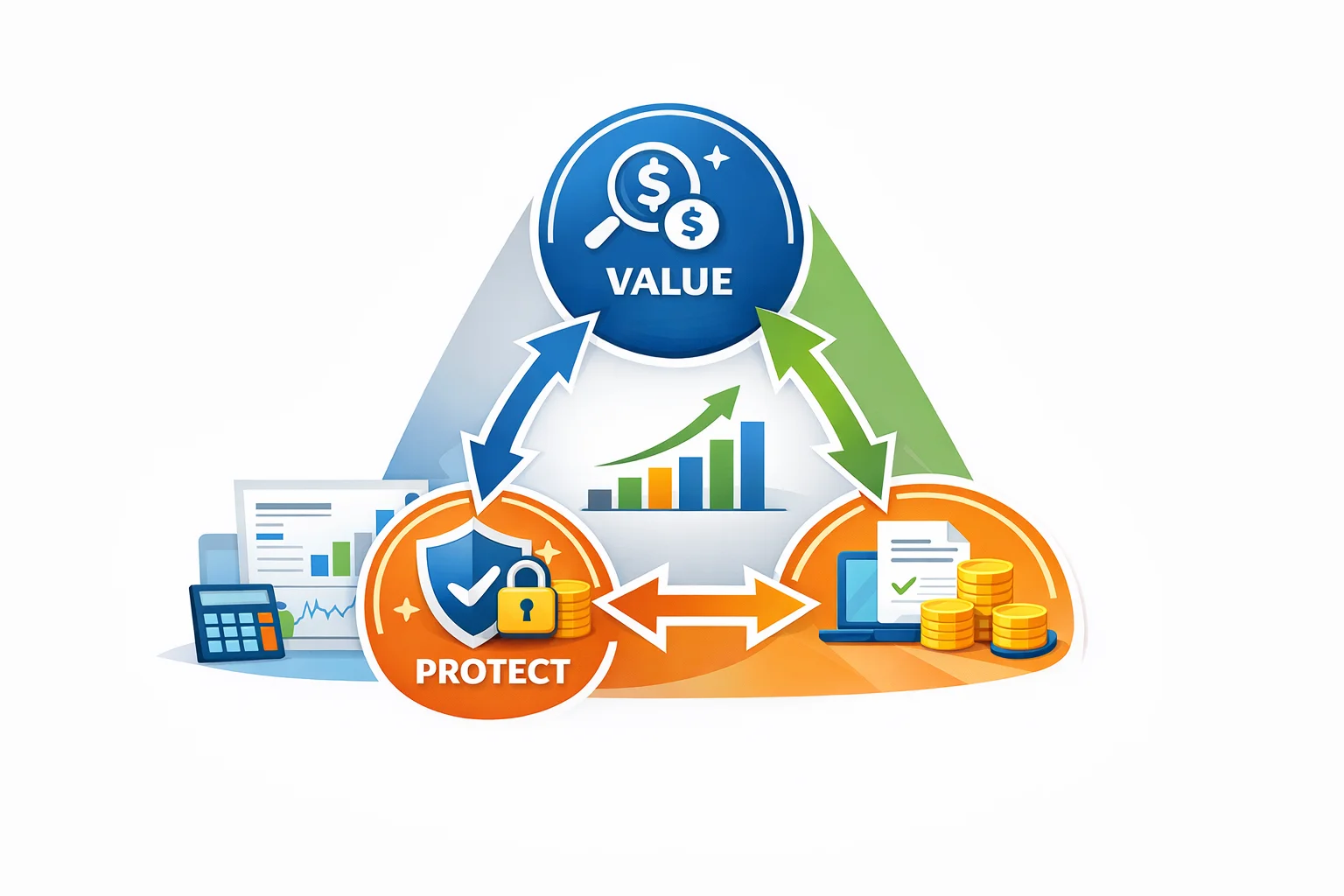
This is where the “Trinity” of modern business finance comes into play. It begins with knowing your exact worth through a precise business valuation calculator, ensuring every strategic decision is grounded in reality. It continues by maximizing your idle capital with business high yield savings, turning dormant cash into a growth engine. Finally, it secures your future by mitigating catastrophic risk with business umbrella insurance. Mastering these three interconnected elements creates a resilient business finance framework that not only safeguards your current assets but also accelerates sustainable growth in an unpredictable world.
Table of Contents
TogglePillar 1 – Know Your Worth: The Strategic Role of a Business Valuation Calculator
Accurate valuation is the bedrock of sound business finance. Without a clear understanding of your company’s true value, you are navigating blind, making critical decisions on lending, partnerships, and expansion based on guesswork rather than data. In the high-stakes environment of 2026, knowing your exact worth is not a luxury; it is a fundamental requirement for effective business finance planning. It dictates your borrowing power, influences investor confidence, and sets the trajectory for your long-term business finance goals.
So, how does a business valuation calculator transform complex data into an actionable strategy? These tools simplify intricate business finance modeling by analyzing key inputs such as annual revenue, EBITDA (Earnings Before Interest, Taxes, Depreciation, and Amortization), and industry-specific market multiples. Instead of hiring expensive consultants for a preliminary assessment, you can calculate a business’s worth online instantly. The algorithm processes these variables to provide a realistic market range, demystifying the business finance equations that often intimidate business owners. By leveraging a business valuation calculator, you turn abstract numbers into a concrete baseline for every strategic move you make.
However, the utility of this tool extends far beyond a single static number. Regular valuations are vital for robust small business cash flow management. By tracking your valuation quarter over quarter, you can identify subtle leaks in your business finance structure, perhaps rising operational costs are eating into margins, or inventory turnover is slowing down. These insights allow you to pivot quickly, optimizing cash flow before minor issues become major crises. Furthermore, if business exit planning is on your horizon, consistent valuation audits ensure you are always “sale-ready,” maximizing your return when the time comes to sell.
Consider this real-world scenario: A mid-sized logistics firm used a business valuation calculator to discover that their operational efficiencies had increased their worth by 20% year-over-year. Armed with this data, they renegotiated their credit lines, securing a 1.5% lower interest rate. This single adjustment, driven by accurate valuation, significantly improved their overall business finance health, freeing up capital for further expansion.
To keep your strategy aligned with reality, make it a standard operating procedure to run a business valuation calculator audit quarterly. This habit ensures your business finance decisions are always grounded in current market realities, allowing you to calculate business worth online with confidence and seize opportunities the moment they arise. By treating valuation as a dynamic pulse check rather than a one-time event, you solidify the foundation of your entire business finance ecosystem.
Pillar 2 – Grow Your Reserves: Maximizing Returns with Business High Yield Savings
Idle cash is a silent killer of business finance performance. In an economy where inflation can outpace traditional savings rates, leaving operating reserves in a standard 0.01% APY account is essentially guaranteeing a loss of purchasing power. This opportunity cost erodes your business finance potential every single day, draining value that could otherwise be reinvested into growth or used as a buffer against downturns. To combat this drag, smart CFOs are turning to business high yield savings accounts as a primary tool for capital efficiency.
The 2026 HYSA landscape offers a compelling solution for these dormant funds. With top-tier institutions now offering rates between 3.5% and 5.0%, a business high yield savings account acts as a risk-free boost to your business finance bottom line. Unlike volatile market investments, these accounts provide guaranteed returns with full liquidity, making them the ideal parking spot for emergency funds, tax reserves, and capital earmarked for near-term expansion. When scouting for the best business savings rates 2026, look beyond the headline APY; consider the stability of the institution and the ease of access. These accounts are no longer just safe havens; they are active contributors to your business finance strategy, generating passive income that directly improves net margins.
Selecting the right account requires a strategic lens typical of advanced corporate liquidity strategies. Key criteria include FDIC insurance limits to ensure total capital protection, withdrawal flexibility to handle unexpected cash needs, and seamless integration with your existing business finance software. An account that syncs automatically with your accounting platform reduces manual reconciliation errors and provides a real-time view of your liquid assets. This integration is crucial for maintaining the agility required in modern business finance, allowing you to deploy capital instantly when opportunities arise.
The impact of these yields compounds over time, creating a powerful snowball effect. The interest earned flows directly into your net income, strengthening your balance sheet. This improved profitability does not just look good on paper; it tangibly increases the output of your next business valuation calculator run, as higher retained earnings are a key driver of company worth. In this way, optimizing your savings rate is a direct form of financial risk mitigation, building a larger cushion against revenue shocks while simultaneously boosting your enterprise value.
To fully optimize business finance liquidity without adding administrative burden, automate your cash management. Set up automatic sweeps to move excess funds from your daily operating account into your business high yield savings every Friday evening. This ensures your working capital is always maximized, earning the best business savings rates 2026 has to offer while you sleep. By treating cash reserves as an active asset class rather than a static backup, you transform your liquidity management into a core pillar of your business finance success, ensuring every dollar is working as hard as you are.
Pillar 3 – Protect Your Empire: Why Business Umbrella Insurance is Non-Negotiable
Protection is the final, critical layer of comprehensive business finance, yet it is often the most overlooked. Many business owners mistakenly believe their general liability policy is sufficient, unaware of the dangerous exposure lurking beneath the surface. Standard policies typically cap out at $1 million to $2 million, leaving your business finance portfolio vulnerable to catastrophic lawsuits that can easily exceed these limits. In a litigious environment like 2026, a single severe accident, data breach, or defamation claim can trigger costs that shatter your balance sheet, exposing critical commercial liability coverage gaps that standard insurance simply cannot fill.
This is where business umbrella insurance becomes indispensable. It acts as a secondary shield, kicking in once your primary liability limits are exhausted. This coverage is far more than just excess money; it covers essential business finance safeguards like extended legal defense costs, settlement fees, and even reputational harm claims that can cripple your brand. For high-net-worth enterprises, business umbrella insurance is the ultimate form of asset protection for business owners, ensuring that a courtroom loss does not translate into a business closure. It plugs the commercial liability coverage gaps that could otherwise drain your operating accounts and force the liquidation of hard-earned assets.
When analyzing cost versus catastrophe, the value proposition is undeniable. Premiums for business umbrella insurance are surprisingly low relative to the millions in coverage they provide, often costing just a few hundred dollars annually for every million dollars of protection. This makes it a high-ROI business finance tool; a modest, predictable expense shields you from existential financial ruin. Framing this insurance as a mere cost is a mistake; it is a strategic investment in continuity. It is the difference between paying a manageable premium and facing a multi-million dollar judgment that wipes out the very value you calculated with your business valuation calculator.
The connection between protection and valuation is direct and brutal. A single uninsured lawsuit can erase years of business finance growth overnight, reducing a thriving company to a shell of its former self. No amount of cash flow optimization or high-yield savings can compensate for a liability judgment that exceeds your coverage limits. Therefore, robust asset protection for business owners is not separate from wealth creation; it is the guardian of it. Without it, the numbers on your balance sheet are fragile, constantly at risk of being nullified by unforeseen legal events.
To maintain a truly resilient posture, you must treat insurance as a dynamic component of your strategy. Recommend reviewing your business umbrella insurance limits annually alongside your business finance audits. As your company grows and your valuation increases, your liability exposure grows with it; your coverage must scale accordingly. This proactive approach ensures that your protection always matches your worth, closing commercial liability coverage gaps before they can be exploited. By integrating business umbrella insurance into your regular financial risk mitigation reviews, you ensure that your empire remains standing, no matter what legal storms arise, securing the future you have worked so hard to build.
Synthesizing the Trinity: A Holistic Business Finance Loop
True mastery of business finance emerges only when you stop viewing valuation, liquidity, and protection as separate tasks and start treating them as a single, interconnected cycle. This is the virtuous business finance loop: as your company grows, your business valuation calculator reveals a higher worth, which in turn demands better yields on your expanding cash reserves through business high yield savings. Simultaneously, that increased value necessitates higher liability limits via business umbrella insurance to safeguard your newly acquired equity. Each pillar reinforces the others, creating a self-sustaining engine of stability and growth where success in one area amplifies the effectiveness of the others.
To maintain this momentum, establish a strict quarterly business finance review meeting. In this session, assess your current valuation, audit your cash yield rates, and verify your insurance limits all at once. This cadence ensures that your business finance strategy evolves in lockstep with your company’s reality, preventing the dangerous drift that occurs when these elements are reviewed in isolation. It transforms business finance from a reactive chore into a proactive strategic advantage.
This holistic approach is the secret weapon for successful business exit planning. Buyers pay a premium for companies that are not just profitable, but also resilient. A business that is accurately valued, earning maximum yield on its cash, and fully protected against liability represents a de-risked asset. It signals to investors that your business finance house is in order, commanding a higher multiple upon sale. Neglecting any one pillar weakens the entire business finance structure, leaving cracks that savvy buyers will exploit to drive down the price. By synthesizing the Trinity, you ensure your company is not just valuable, but invaluable.
Conclusion
Mastering modern business finance requires more than isolated tactics; it demands the synergy of three essential pillars. You must know your value through a precise business valuation calculator, grow your reserves with high-yield accounts, and protect your empire with comprehensive umbrella insurance. True business finance mastery is not about optimizing one tool; it is about integrating all three into a resilient framework that withstands market volatility.
Do not wait for a crisis to reveal your gaps. Take action this week: run a fresh valuation, switch your idle cash to a high-yield account, and audit your insurance coverage. By securing these three fronts today, you future-proof your business finance strategy, ensuring your company is built not just for profit, but for a lasting legacy. This is the only path to sustainable business finance success in 2026 and beyond.